Hello and welcome to Current, the newsletter that helps you navigate this new era of electricity. I’m your newsletter host, Catherine Morehouse Gernes.
Hot Topic
One big thing to put on your radar
There’s no question. Utility bills are on the ballot this November.
The cost of electricity service for residential customers has risen an average of $45.79 per month across the U.S. since the start of 2021, representing a nearly 40 percent jump in bills, according to PowerLines’ new State Utility Dashboard. These figures occur against the backdrop of growing consumer anxiety over rising energy costs, which remains at an all-time high.
Meanwhile, constituents across 39 states will elect officials this November with the authority to tackle rising costs. That had us wondering: What kinds of solutions are candidates promising on the campaign trail? And will they stick to those pledges once elected?
To answer those questions, we decided to compile a comprehensive database detailing how candidates running for governor or public utilities commissioner (PUC)—seats with a high degree of authority over state utility costs—talk about energy affordability on the campaign trail.
I’ve since scoured these platforms to better understand how energy affordability has shaped this year’s race—and how it might shape energy policy in 2027. Here are a few of my key takeaways:
- Nearly every PUC and gubernatorial candidate mentions energy affordability on their campaign website. More specifically, 61 of 74 gubernatorial candidates* and 30 of 33 PUC candidates** have a position on energy affordability.
- Candidates running for governor have pledged to protect consumers against costs incurred by large loads like data centers, to increase utility transparency and accountability, and some explicitly mention PUCs as a key solution. 20 candidates have pledged to protect ratepayers from grid costs associated with data centers, 19 have pledged increased accountability and transparency, and 10 have explicitly mentioned their state PUCs as part of their plan to lower energy costs.
- PUC candidates have pledged to protect consumers and/or lower utility costs (listed by 26 candidates), increase utility transparency and accountability (listed by 16 candidates), and tackle data center concerns (listed by 10 candidates).
- Electricity bills have skyrocketed in several key battleground states since 2020. That includes a 58.1 percent jump in Ohio, 50.1 percent in Texas, 37.6 percent in Arizona, 35.9 percent in Oregon, 32 percent in Georgia, 29.9 percent in Michigan, and 24.6 percent in Wisconsin.
Zooming in further, a few key races stand out:
- In Maine, gubernatorial candidates Bobby Charles, R, and Hannah Pingree, D, have lengthy and specific plans to lower energy costs in the state, which have risen more than 50 percent over the past five years. Both explicitly mention the state’s PUC as part of their affordability plan.
- In Michigan, where the state’s two largest utilities have filed back-to-back rate increases worth hundreds of millions of dollars, candidates for governor Jocelyn Benson, D, and John James, R, both have comprehensive pledges to address rising energy costs and tamp down on rate increases.
- Consumer concern over growing data center footprints and associated rising energy costs has dominated both the Ohio governor campaigns of Vivek Ramaswamy, R, and Amy Acton, D, and the Texas governor campaigns of incumbent Greg Abbott, R, and opponent Gina Hinojosa, D.
- In Georgia, Peter Hubbard, D, and Fitz Johnson, R, are facing each other again, just one year after Hubbard ousted Johnson. Hubbard was one of two Democrats in 2025 to secure a seat on the Public Service Commission—the first time any Democrat had won a seat on the PSC in more than 20 years. A third seat, representing District 5, is up for grabs, which could flip the commission to Democratic control. Both candidates Shelia Edwards, D, and Josh Tolbert, R, have pledged to address energy affordability.
- Two seats are up for grabs at the Arizona Corporation Commission, with three non-incumbents in the race. Ralph Heap, R, Jonathan Hill, D, Clara Pratte, D, and incumbent Kevin Thompson, R, are all running for two at-large seats in the state. Arizonans have seen their monthly electricity bills rise nearly $50 on average since 2021, and utilities in the state expect to spend another $22 billion by the end of the decade.
*Several incumbent candidates have more sparse campaign websites, but detailed records on energy affordability, which are included in the database.
**The two PUC candidates who do not have a position are in Nebraska, the only state in the U.S. with an electric grid run entirely by public power. This means that the public utility boards, not the PUC, have authority over rates. Thanks to a tip from a reader, I compiled the campaign positions of key Nebraska board member seats under challenge. Click on Nebraska to learn more!
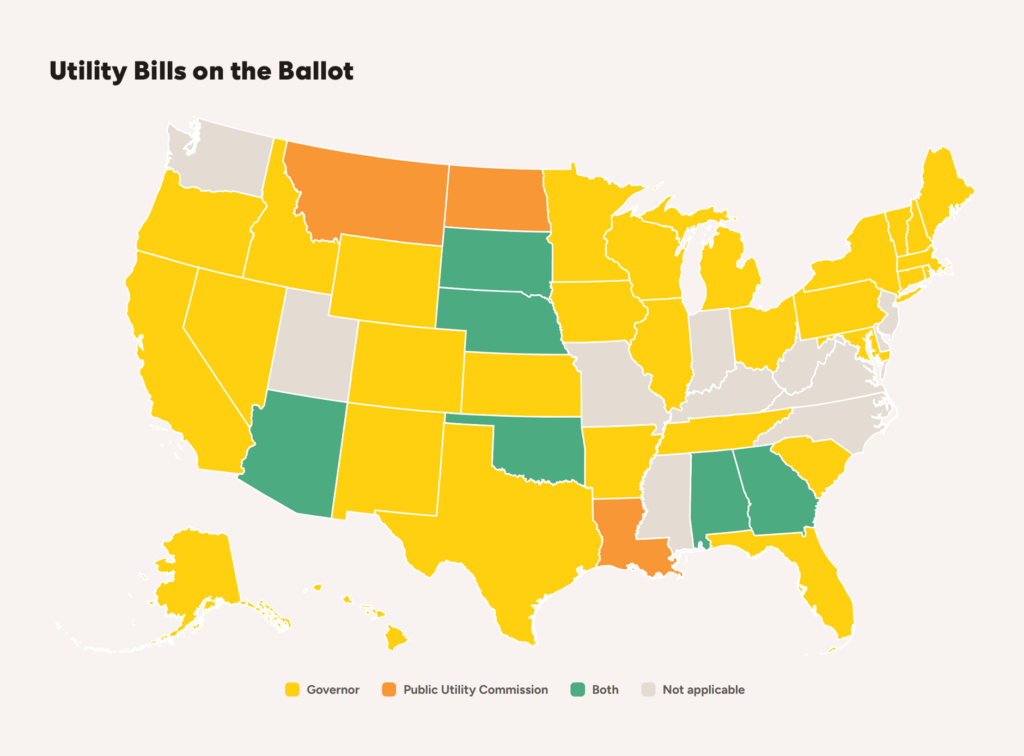
Image of the Week
Several seats are up for grabs that have the power to lower energy costs: 36 states have a governor’s election and 9 have PUC elections.
PowerLines Utility Bills on the Ballot Dashboard
New and Notable
A roundup of other relevant energy developments
In California: A California PUC administrative law judge recommended the agency deny a proposal from San Diego Gas and Electric to kill its energy efficiency programs, citing widespread consumer benefits from the programs and concerns about cutting efficiency efforts amid rising costs.
SDG&E had asked for permission to stop administering its regional efficiency program, arguing its programs are not cost effective. The state is aiming to double energy efficiency savings for gas and electric utility customers by 2030.
But in its proposed decision put before the commission Oct. 8, the ALJ found the vast majority of the utility’s programs were cost effective, and that their long-term benefits—including reduced wholesale costs and other grid benefits—are too valuable to cut, particularly in an era of unpredictable demand growth. Finally, the ALJ argued that the programs are simply too critical for consumers currently struggling to pay their monthly bills.
“[E]nergy efficiency programs are among the most effective tools in the regulatory environment that we can provide to customers facing affordability challenges, to help them make permanent reductions in their energy use,” the ALJ wrote.
In Minnesota: The Minnesota PUC denied a petition on Oct. 1 from the state’s attorney general and Citizen Utility Board to reconsider its decision to increase the rate of return Xcel Energy can recover from customers as part of its spending on power grid infrastructure.
The commission is in the midst of an investigation into rising utility costs, which included Oct. 13 testimony from AG Keith Ellison. In his remarks, Ellison acknowledged the commission’s need to balance utility profits and consumer interests, but argued the needs of customers—particularly small business customers—may be more “complex” than the demands of utility shareholders.
“As you seek to balance competing pressures, I hope this ongoing dialogue helps you always keep in mind the folks trying to make ends meet or keep their small business afloat,” the AG told the commission at its first informational session as part of the investigation. “Right now, Minnesotans are telling anyone who will listen that they want a better chance to afford their lives — and more than that, to prosper. My office is listening. I know you all are, too.”
In Pennsylvania: The Pennsylvania Office of Consumer Advocate filed a complaint with the state PUC on Oct. 2 arguing that current utility rules leave electricity customers on the hook for the rapid expansion of data centers connecting to the state’s power grid. The office points to several instances in which PPL Electric Utilities allocated costs for upgrades meant to serve rising data center load disproportionately to non-data center ratepayers.
In Virginia: Governor Abigail Spanberger released a comprehensive energy plan on Oct. 1 that includes specific recommendations aimed at realigning utility incentives, grappling with data center load growth, and advancing key grid technologies that can lower energy costs.
The plan, which is required by state statute every four years, calls for all data centers pay for the grid costs they cause, require new large data centers to demonstrate that they can quickly curtail power when necessary, and increase transparency on how data centers impact grid costs, and how those costs are allocated.
Spanberger’s plan also urges the state to reform its policy on how it allows utilities to recover profits from customers, and to advance new regulatory standards that better align utility performance with profit incentives.
Docket Corner
New utility proceedings to keep an eye on
We update our docket search monthly. Check out our last roundup here and check back next issue for an update!
Job Board
A snapshot of the latest PUC job postings
For a full list of job openings at commissions across the country, check out our full PUC Jobs Board.
- Attorney Office of Consumer Affairs — Wyoming Public Service Commission
- Lead Utility Finance Specialist — Virginia State Corporation Commission
- Oil and Gas Specialist I — State of Oklahoma
- Social Media Coordinator — New Mexico Public Regulation Commission
- Public Utilities Rates Analyst 3- Rates Analyst — Minnesota Public Utilities Commission
News You Can Use
- Rising interest rates challenge utility financing plans, US Bank managing director says — Utility Dive
- Duke Energy agrees on new rules for large energy users like data centers — Axios
- Collins, Jackson spar over energy costs, health care in third Maine Senate debate — WABI 5
- ‘We just shut the faucet off’: Eversource CEO sparks outrage over CT spending comments, lawmakers want answers — Eyewitness News 3
- PUC candidates talk data centers and affordability in utility pricing — South Dakota Public Broadcasting
- Affordability tops the list of energy concerns for Arizonans — Arizona Capitol Times
- Michigan AG Nessel argues against Consumers Energy rate hike request — ABC12 News
- Nebraskans are used to cheap energy, but the aging grid and data centers are driving costs up — Nebraska Public Media
Have a question for one of our experts? Any suggested topics you’d like to see us cover? Feel free to send us your utility bill, share your story, or ask us a question: current@powerlines.org.
Have a specific question or tip for me? Get in touch: catherine@powerlines.org.
PowerLines is a nonpartisan consumer education nonprofit organization that aims to modernize the utility regulatory system for American energy consumers to lower utility bills and grow the economy.