Hello and welcome to Current, the newsletter that helps you navigate this new era of electricity. I’m your newsletter host, Catherine Morehouse Gernes.
Hot Topic
One big thing to put on your radar
Rising utility bills have become commonplace in almost every state. Despite the growing amount of attention paid to this issue—including pledges from elected officials and utility executives who say they are committed to lowering energy costs—nearly every quarter PowerLines finds that utility requests to hike energy rates are continuing to rise.
The third quarter of the year was no different. Electric and gas utilities requested a new Q3 record of $4.5 billion—bringing the year’s total to $23.1 billion, according to PowerLines’ latest “Utility Bills are Rising” quarterly report.
In case you’re not familiar with our reports, we track new utility rate requests each quarter to maintain an ongoing index of approximately how much gas and electricity companies requested over that period.
This quarter, I took our research a step further and dug into the individual filings to better understand what is actually driving these rate requests.
With that in mind, here are a few key takeaways from my analysis:
- Increased utility spending on transmission and distribution made up the bulk of utility rate requests this quarter.
- At least 15 utilities cited transmission or distribution investments as a catalyst of their rate requests—and $2.8 billion of the $3.6 billion requested was at least partially driven by T&D spending.
- Profit considerations, including an increased return on utility investments and earnings shortfalls were the second highest factor cited. In multiple cases, for instance, gas utilities requested rate increases to make up for mild winter weather that led to lower gas use—and therefore lower earnings for the company.
- At least 13 utility filings worth $1.7 billion in potential rate hikes mentioned profit-related needs as part of their request.
- Extreme weather, while less frequently cited, appeared to punch above its weight in cost. Those costs were cited across five utility filings totaling $1.1 billion.
These utility rate hike requests reflect their underlying business model. Utilities are motivated to build new infrastructure rather than getting more out of the existing system because the utilities earn an authorized rate of return on their investment—which currently averages around 9.84 percent. These investments in items such as new distribution and transmission lines, and the rate of return, much of which goes to a utility’s profit margin, will eventually show up on consumers’ bills.
Simultaneously, several filings show utilities are asking regulators to increase the rate of return they receive. Utilities argue they need the higher rate to counter inflationary pressures that raise the cost of materials and labor, volatile weather events, and rising fuel costs.
As PowerLines’ experts and analyses frequently point out, there is a better way to design the utility regulatory system to better align utility profit motives with consumer interests, while also accounting for growing industry challenges. Elected officials have several tools at their disposal to ensure the regulatory system works better for all—and to finally give consumers a break from ever-rising utility bills.
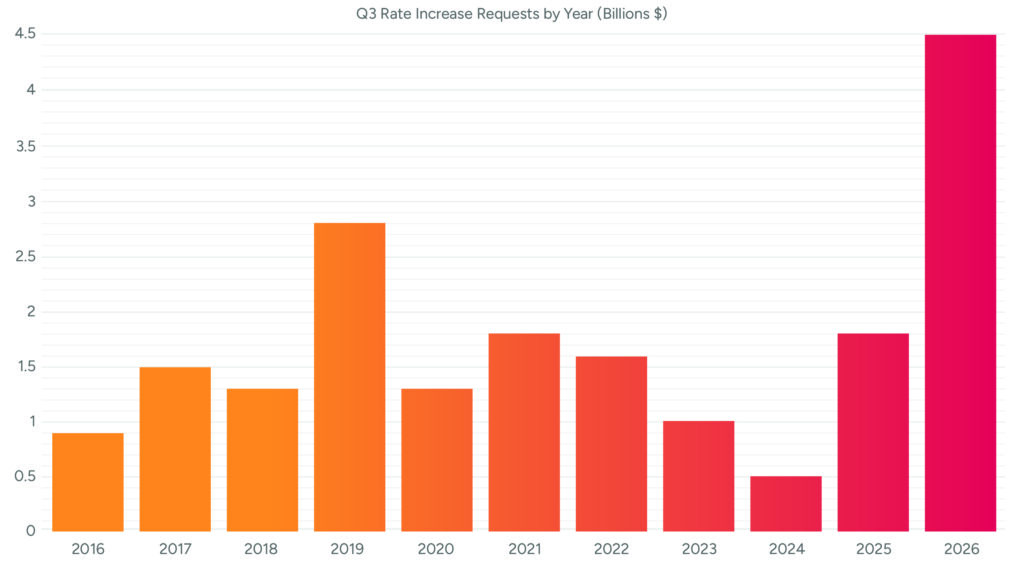
Image of the Week
Utilities once again broke a quarterly record—requesting $4.6 billion in rate hikes in the third quarter of 2026 alone.
Nina Besl for PowerLines.
New and Notable
A roundup of other relevant energy developments
New Resources: PowerLines has released two new tools to help the public better track how electricity bills are rising in their state, and to see how politicians are talking about energy affordability on the campaign trail.
- “State Utility Dashboard” gives consumers a clear-eyed view into who regulates their utility, how much bills in their state have risen, and how much more utilities are planning to spend.
- “Utility Bills on the Ballot” tracks how candidates running for public utilities commissions and governor seats are discussing energy affordability on the campaign trail.
Both resources aim to arm voters, consumers, policymakers, journalists, and others with the tools they need to understand what is happening with their local utility bills—and what candidates are pledging to do about it.
On Capitol Hill: A bipartisan coalition of senators unveiled long-awaited permitting reform language early last week that, if passed, could have a massive impact on how the U.S. builds new energy infrastructure—and how it gets paid for.
The Bipartisan American Affordability and Jobs Act could make it easier to build large energy infrastructure projects, such as high-voltage transmission lines. That could lower costs for consumers by making it easier to build a more efficient grid instead of the piecemeal way transmission and distribution often gets built. The bill also aims to ensure data center developers pay for any new grid infrastructure built to serve their energy demand, to prevent those costs from being shifted onto other consumers.
But the bill has a long way to go before it becomes anywhere close to law. Senators will not vote on the legislation until the post-election lame duck session, and rumored amendments are already being floated.
At FERC: The Federal Energy Regulatory Commission (FERC) cited rising affordability concerns in its decision to suspend a proposal from 13-state power market PJM Interconnection.
PJM’s plan aimed to significantly boost the power supply of the market, whose massive footprint stretches across the data center-rich territory of the Mid-Atlantic and parts of the Midwest. The plan was proposed in response to backlash over skyrocketing power prices due to rising costs of maintaining grid reliability amid increasing demand, largely from those data centers.
In its suspension, federal regulators questioned whether it appropriately allocated costs across different consumer classes—and blasted PJM for giving the commission insufficient time to review a complex plan that could have major implications for energy costs.
“American ratepayers and utilities need urgency, clarity, and discipline—none of which PJM appears capable of delivering at this time,” wrote FERC Chair Laura Swett in a concurring statement.
“This Commission will not be forced into accepting a deeply flawed, eleventh-hour procurement mechanism with billion-dollar implications for consumers,” she added.
In Minnesota: The Minnesota Public Utilities Commission opened an investigation into the affordability of electric and gas service from rate-regulated utilities. According to the commission, the investigation will assess what drivers are affecting consumer bills, and whether regulatory or legislative changes are needed.
The commission will host informational sessions on Oct. 13, Nov. 2, and Dec. 8, and will accept written comments and recommendations from the public.
Docket Corner
New utility proceedings to keep an eye on
- Oklahoma Gas and Electric filed a request to increase its Oklahoma annual retail revenues by $395 million, which will increase average residential electric bills by
- $23.88 per month.
- Docket Number: 2026-000067
- Filed at: Oklahoma Corporation Commission
- Filing Date: September 30, 2026
- Ameren Missouri filed its 2026 Integrated Resource Plan.
- Docket Number: EO-2027-0098
- Filed at: Missouri Public Service Commission
- Filing Date: Sept. 28, 2026 (Open)
- DTE Energy filed its 2026 Integrated Resource Plan.
- Docket Number: U-22168
- Filed at: Michigan Public Service Commission
- Filing Date: Sept. 24, 2026
- Black Hills Colorado Electric filed its 2026 Electric Resource Plan, Clean Energy Plan, and 2027-2030 Renewable energy compliance plan.
- Docket Number: 26A-0333E
- Filed at: Colorado Public Service Commission
- Filing Date: Sept. 11, 2026 (Active)
- The Potomac Edison Company, a FirstEnergy subsidiary, filed a request to increase its Maryland annual base rate distribution revenues by $52.8 million, which will increase average residential electric bills by $9.47 per month.
- Docket Number: 9904
- Filed at: Maryland Public Service Commission
- Filing Date: Sept. 4, 2026
- Evergy Missouri West filed a notice that it intends to initiate a proceeding to increase its electric rates within 60 days from the filed notice.
- Docket Number: ER-2027-0077
- Filed at: Missouri Public Service Commission
- Filing Date: Sept. 1, 2026 (Active)
Job Board
A snapshot of the latest PUC job postings
For a full list of job openings at commissions across the country, check out our full PUC Jobs Board.
- Assistant Public Information Officer — New York Department of Public Service
- Regulatory Compliance Manager — Missouri Public Service Commission
- PSC Regulatory Administrative Specialist 1-3 — Louisiana Public Service Commission
- Public Utilities Commission District Representative — Hawaii Public Utilities Commission
News You Can Use
- NJ utilities board votes to keep electricity rates level — New Jersey Monitor
- US Grid’s $1 Trillion Problem Could Equal a $1 Billion Payout for Power CEOs — EnergyNow Media
- Georgia Public Service Commission candidates debate data centers — Decaturish
- Affordability concerns drive momentum for performance-based ratemaking — Utility Dive
- Detroit utility payments jump 15% — Axios
- US utility profits come under fire over data centre demand — Financial Times
Have a question for one of our experts? Any suggested topics you’d like to see us cover? Feel free to send us your utility bill, share your story, or ask us a question: current@powerlines.org.
Have a specific question or tip for me? Get in touch: catherine@powerlines.org.
PowerLines is a nonpartisan consumer education nonprofit organization that aims to modernize the utility regulatory system for American energy consumers to lower utility bills and grow the economy.