Hello and welcome to Current, the newsletter that helps you navigate this new era of electricity. Current distills the complex and evolving energy landscape—and shows how modernizing the utility regulatory system can lower utility bills and grow the economy. I’m your newsletter host, Catherine Morehouse Gernes, a former energy journalist who previously covered the power grid at POLITICO and Utility Dive.
Have a question for one of our experts? Is there a wonky utility concept you want to understand better? Any topics you’d like to see us cover? Feel free to send us your utility bill, share your story, or ask us a question: current@powerlines.org.
Have a specific question or tip for me? Get in touch: catherine@powerlines.org.
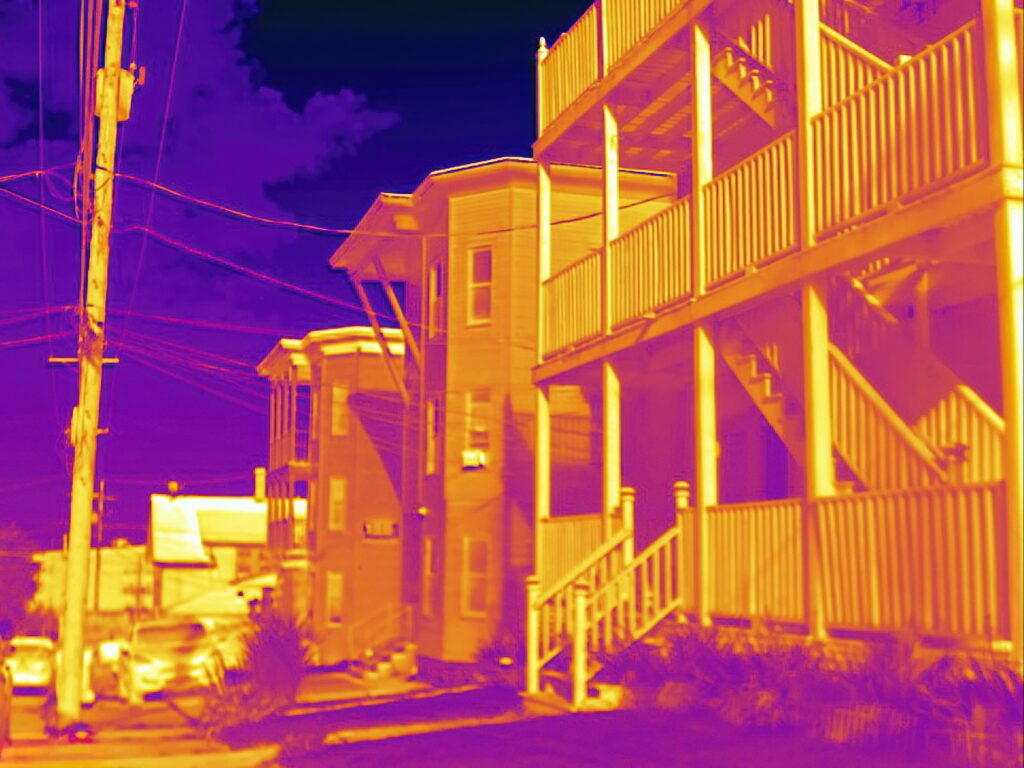
Image of the Week
A thermal image shows a residential street in Woonsocket, Rhode Island, in July. The warmer yellows indicate temperatures over 80 degrees, while purple indicates cooler temperatures.
Photo by Greg Kahn for PowerLines.
A note from PowerLines
Welcome to the inaugural issue of Current, PowerLines’ new newsletter!
As PowerLines is one of the only national organizations focused on utility regulation and energy affordability, we see a key goal of ours as providing sharp clarity and strategic insights to a wide range of stakeholders around the opaque but critical decisions and processes that shape our utility regulatory system. Case in point: just 200 PUC commissioners oversee more than $200 billion each year in utility spending. We call them the “Supreme Court justices of energy”—and we want you to be informed and thoughtful about what this means for your work.
The U.S. energy system is at an inflection point, with skyrocketing electricity prices and rising demand for electricity driven by data centers and manufacturing to a degree we haven’t seen in over a generation. This has led to a new “politics of electricity,” one where politicians and policymakers are increasingly vocal about utility issues and investors and companies increasingly need to come up to speed on complex utility regulatory issues. We aim to be a translator for this key moment by explaining in plain terms what’s happening in the energy world and why it matters.
Our team of former utility regulators, governors’ energy advisers, consumer advocates, journalists, and other experts already fulfills that mission through our quarterly indexes that track and explain utility rate requests, our annual report on utility capital expenditure plans that previews how much utilities are planning to spend long-term, our annual polling on consumer sentiment, our policy playbooks that outline the levers policymakers have to address these issues, and other avenues where we can engage with decision makers and stakeholders, like you.
This newsletter is intended to help guide readers through the complex, constantly changing world of utility regulation. Here, you can expect our take on key developments in the energy regulatory space, as well as a roundup of relevant utility and regulatory news across the country. We also want to hear from you, our readers, both as experts in your field and as utility customers. What frustrates or excites you about this current moment in U.S. energy policy? What do you want to hear from us?
We look forward to paving a new path forward for our energy system alongside you. Buckle up.

—Charles Hua, PowerLines Founder and Executive Director

Hot Topic: A rate case reversal in Indiana
One big thing to put on your radar
In an extraordinary move that highlights increasingly forceful action from Indiana state leadership to combat rising energy costs, the Indiana Utility Regulatory Commission (IURC) voted 3-1 on Sept. 2 to revisit its earlier vote approving a $71 million rate hike for utility AES.
Granting a rehearing on a rate case is exceedingly rare both in Indiana and nationally. I personally could not find a previous instance of the IURC revisiting a rate hike decision over the last 20 years based on consumer concerns and could find very few nationwide. (If you know of one, send us a note!)
One of the unique twists in the case is how different the commission that approved the rate hike three months ago looks from the commission that voted to revisit the case.
Governor Mike Braun has exerted extraordinary pressure on regulators, including through a dramatic shakeup in commission leadership.
Braun demoted and then fired then-chair of the commission, Andy Zay, following the IURC’s approval of the rate hike. Another commissioner resigned following the vote. Braun then urged the state’s consumer advocate to request a rehearing on the case and moved quickly to replace the two regulators—meaning four of the five sitting commissioners are now Braun appointees. The sole dissenting vote, David Ziegner, is not a Braun appointee. Chair Anthony Swinger who previously worked for the consumer office, which requested the rehearing, did not participate.
Combined, Braun’s actions represent an unprecedented exertion of executive power over an individual utility rate case. There are 36 governor seats up for reelection this fall. We’re keeping a close eye on whether other administrations follow Braun’s lead and begin to exert their authority more aggressively as rising energy rates become impossible to ignore.
New and Notable
A roundup of other relevant energy developments
In Alabama: The state’s first rate case in 40 years could yield savings for customers after a monumental decision earlier this month.
Spire gas utility subsidiaries Spire Alabama and Spire Gulf had asked the PSC to raise their average return on equity (ROE) from 9.7 percent to 10.5 percent and 9.95 percent to 10.75 percent, respectively. Instead, after the commission’s first-of-its-kind investigation, the PSC examined Spire’s books and voted to drop the utilities’ rates to 9.4 percent and 9.6 percent, respectively. The vote came after the commission’s administrative law judge found evidence in the case did not justify the higher ROE Spire had requested. The commission, however, did approve an increase in the utility’s fixed monthly charge, which it said made the final change “revenue neutral” for the company.
Alabama operates under unique laws that allow utilities to receive rate increases through automatic adjustments based on a set formula, rather than through a public rate case. Alabama has not had a formal rate case proceeding since 1981—though some state lawmakers and PSC candidates are hoping to change that.
The state’s biggest electric utility, Alabama Power, sought and received a rate freeze—later signed into law—through 2029, after blowback from consumers facing some of the highest bills in the country. Prior to the rate freeze, the company had three rate increases in 2022 alone.
In Minnesota: State officials and consumer advocates are urging the state’s public utilities commission to reconsider its decision to approve an increase to utility Xcel Energy’s ROE.
The PUC approved a $211 million hike over two years, including a 9.6 percent ROE—which represents a slight bump above Xcel’s previous rate of 9.25 percent. The ROE bump alone is expected to cost consumers an additional $34 million per year.
Attorney General Keith Ellison, the Department of Commerce, the Citizens Utility Board, and others have all weighed in on the case.
In Montana: A task force under the direction of Governor Greg Gianforte released a report of energy recommendations earlier this month aimed at boosting the state’s supply of generating resources and lowering energy costs.
His first recommendation? Reform utility regulation.
Gianforte urged the legislature to pursue statutory changes that would reform the state’s public service commission “to improve regulatory efficiency, transparency, and consistency in decision-making.” Among the reforms he recommended was considering transitioning the PSC from elected to appointed. (Two of Montana’s five commission seats are up for reelection this fall).
Docket Corner
New utility proceedings to keep an eye on
- ER26080420: Jersey Central Power & Lt Co — Docket Filing Date: Aug 6, 2026 (Pending)
- Jersey Central Power & Light Company has filed a request to raise base rates by $253 million per year, while adding a storm recovery charge that would add an additional $57.4 million per year to rates for the next decade.
- 2026-000067: Oklahoma Gas & Electric Co — Docket Filing Date: Aug 14, 2026 (Pending)
- Oklahoma Gas & Electric Co. notified regulators that it plans to file an application to adjust electricity rates. The application is expected around Sept. 30.
Job Board
A snapshot of the latest PUC job postings
For a full list of job openings at commissions across the country, check out our full PUC Jobs Board.
- Regional and FERC Attorney — Wyoming Public Service Commission
- Damage Prevention Investigator 3 — Washington Utilities and Transportation Commission
- Public Utility Regulation Manager (Hybrid) — Virginia State Corporation Commission
News You Can Use
- Costs take center stage at New York’s Climate Week — Axios
- NextEra Energy Reaffirms 2026 Guidance at Top End of Range as $67 Billion Dominion Merger Progresses — The Wall Street Journal
- Senate roadblock sparks new competition over data center bills — POLITICO
- Google reveals $10M investment in energy affordability in Nevada — Las Vegas Review Journal
- Pennsylvania utility commission to review how utility profits, data centers affect affordability issues — WHYY
- NY PSC Opens Inquiry into Utility Use of Artificial Intelligence, Initiates Energy Affordability Index Proceeding — Daily Energy Insider
- Dominion, NextEra propose $1 bln-a-year Virginia supplier program — Reuters
- Vermont regulators finalize 5.5% rate increase for Green Mountain Power customers — VT Digger
PowerLines is a nonpartisan consumer education nonprofit organization that aims to modernize the utility regulatory system for American energy consumers to lower utility bills and grow the economy.